
WELCOME BONUS 300%
UP TO €2000 + 100
FREE SPINS
UP TO €2000 + 100
FREE SPINS
Home → Blackjack
Blackjack at Martin Casino: Variants, Rules and Payouts
Why Loss Progression Quickly Reaches Table Limit
The Blackjack 6 Decks variant features a base strategy house edge of 0.46 percent, which directly impacts the bankroll during any winning streak progression. This mathematical advantage ensures that the casino retains a small percentage of every wager over time, making consistent profit difficult for players attempting to recover losses through increased bets. Consequently, a player must have sufficient funds to withstand variance without hitting the table maximum.
Lightning Blackjack from Evolution imposes a maximum bet limit of 2,500 EUR, which caps the potential size of any single wager regardless of the player's confidence level. This restriction prevents high-stakes progression systems from functioning effectively, as the betting ceiling is reached long before theoretical loss recovery becomes possible. The presence of Lightning Multipliers up to 25x adds volatility but does not alter the fundamental constraint on total exposure per round.
Infinite Blackjack by Evolution allows wagers up to 5,000 EUR, offering a higher ceiling than its Lightning counterpart but still restricting aggressive Martingale strategies. A player losing ten consecutive hands with a doubling sequence starting at one euro would require significant capital to reach this limit safely. The table supports unlimited seats, meaning competition for the specific seat configuration remains constant across all sessions.
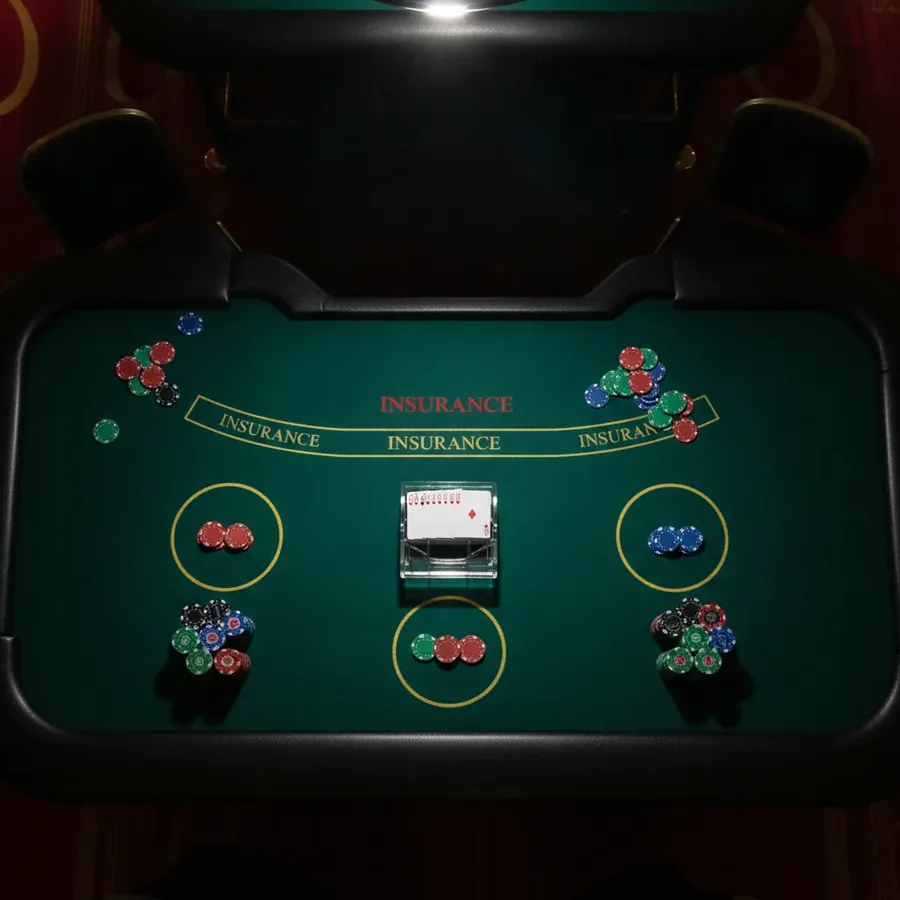
How many decks are in the shoe?
The standard Blackjack 6 Decks game utilizes six full packs of cards, creating a continuous shuffle environment that significantly increases the house edge compared to single-deck variants. This configuration results in a reported RTP of 99.54 percent, assuming optimal play with a dealer standing on soft seventeen rules. Players relying on card counting techniques find this method highly ineffective due to the frequent reshuffling and large deck penetration.
Blackjack Ein Deck operates with only a single pack of cards, delivering a superior RTP of 99.85 percent and reducing the house advantage to just 0.15 percent. The reduced number of cards allows for more accurate tracking of remaining high-value cards, theoretically giving skilled players a measurable edge over the house. However, this benefit is often neutralized by stricter rule sets or lower payout ratios for natural blackjacks found in other tables.
Blackjack Party from Evolution maintains a multi-deck shoe structure similar to traditional games, supporting a betting range from 1.00 EUR to 1,000 EUR. The use of multiple decks ensures rapid game flow and minimizes downtime between rounds, catering to a high-energy atmosphere moderated by two hosts. This setup prioritizes speed and entertainment value over the strategic depth offered by single-deck variations.
Soft 17: Dealer Hits or Stands
Blackjack Split / Double / H17 variants force the dealer to hit on soft seventeen, adding exactly 0.22 percentage points to the house edge compared to standing rules. This specific rule change negatively impacts player profitability by increasing the likelihood of the dealer busting less frequently when holding a vulnerable hand. Players must adjust their basic strategy accordingly to mitigate the increased risk associated with this dealer behavior.
Standard Blackjack 6 Decks requires the dealer to stand on soft seventeen, contributing to the favorable 0.46 percent house edge and 99.54 percent RTP figure. Standing on soft seventeen reduces the dealer's ability to improve weak hands, thereby increasing the probability of player wins in marginal situations. This rule is considered essential for maintaining a low house advantage in modern online blackjack environments.
Infinite Blackjack from Evolution adheres to strict standing rules on soft seventeen, ensuring the RTP remains stable at 99.47 percent across all seats. The consistency of this rule across unlimited players means that individual actions do not influence the underlying mathematics of the shoe. Side bets like Any Pair or 21+3 remain unaffected by the dealer's soft seventeen handling, though they carry their own distinct odds.
When does the table max bet apply?
The Lightning Blackjack table enforces a maximum bet limit of 2,500 EUR, which applies uniformly to all players regardless of their account balance or VIP status. This cap restricts the magnitude of potential payouts from Lightning Multipliers, as the base wager cannot exceed this threshold even if the player wishes to wager more. The rule protects the casino from excessive liability while maintaining game integrity for the majority of participants.
Infinite Blackjack offers a significantly higher maximum bet allowance of 5,000 EUR, accommodating high rollers who prefer larger stakes and faster turnover rates. This elevated limit allows for more substantial exposure per hand, though it does not guarantee proportionally higher returns due to the fixed house edge. The table supports unlimited players, ensuring that the maximum bet rule applies equally to everyone seated at the virtual table.
Blackjack Party restricts wagers to a maximum of 1,000 EUR, reflecting its focus on casual gameplay and entertainment rather than high-stakes competition. This lower ceiling aligns with the party atmosphere created by the two moderators, targeting a broader audience of recreational players. The betting range starts at 1.00 EUR, providing accessibility for beginners while capping professional advantage-seeking behaviors.
Continuous Shuffling Machine shuffles after each round
Blackjack Ein Deck relies on manual shuffling procedures rather than continuous machines, allowing the shoe to run until penetration levels justify a reshuffle event. This process enables card counters to track the composition of remaining cards, potentially identifying favorable situations where the true count exceeds positive thresholds. The absence of a CSM is a critical factor in achieving the low 0.15 percent house edge associated with this variant.
Lightning Blackjack from Evolution employs continuous shuffling mechanisms to ensure immediate recycling of cards after every single round played by all participants. This technology eliminates any possibility of card counting, forcing players to rely solely on luck and basic strategy for every new hand dealt. The resulting randomness contributes to the 99.56 percent RTP, which assumes perfect play without any predictive advantages.
Infinite Blackjack utilizes continuous shuffling to maintain an uninterrupted flow of games across its unlimited seating capacity, preventing delays between rounds. This method ensures that the 99.47 percent RTP remains statistically accurate over time, as no historical data from previous hands influences future outcomes. The system supports four side bets independently of the main game, adding layers of complexity to the purely random distribution.
Blackjack variants at a glance
| Variant | Payout | House edge | Rule | Bet range |
|---|---|---|---|---|
| Blackjack Surrender (Late Surrender) – Regel-Effekt | n.a. (Regel-Modifikator) | −0.08 Prozentpunkte | Spieler gibt Hand nach Dealer-Blackjack-Prüfung auf, verliert die Hälfte des Einsatzes. Verbessert RTP um ca. 0.08 Prozentpunkte. Early Surrender ist wesentlich wertvoller (bis −0.6 Prozentpunkte), aber extrem selten. | Rückzahlung 50% des Einsatzes |
| Blackjack Insurance / Versicherung (6–8 Decks) | 92.53% | 7.47% | Separate Nebenwette bis 50% der Hauptwette, wenn der Dealer ein Ass hat. Basisstrategie schreibt IMMER Ablehnung vor (außer Karten zählen bei True Count ≥ +3). Bei einem Deck Vorteil ≈ 5.88% | Insurance 2:1 |
| Blackjack Split / Double / H17 – Regel-Effekte | n.a. (Regel-Modifikatoren) | H17 +0.22 Prozentpunkte; RSA −0.08 Prozentpunkte; DAS −0.14 Prozentpunkte | Dealer Hits Soft 17 verschlechtert RTP um 0.22 Prozentpunkte; Resplit Aces verbessert um 0.08 Prozentpunkte; Double After Split verbessert um ca. 0.14 Prozentpunkte; 6 Decks statt 8 – ca. 0.02 Prozentpunkte. | Double – Einsatz ×2 mit einer Karte; Split – bis 4 Hände; Ass-Split meist mit einer Karte. |
| Blackjack 6 Decks, S17, DAS, DOA, Auszahlung 3:2, Basisstrategie | 99.54% | 0.46% | Dealer steht auf Soft 17; Verdopplung auf jeder Zweierkarte; Verdopplung nach Split erlaubt; keine Aufgabe. Basisstrategie ist für diesen Wert zwingend | Blackjack 3:2, normaler Gewinn 1:1, Insurance 2:1 |
| Blackjack Liberal Vegas Strip (liberale Regeln, 3:2) | 99.72% | 0.28% | Günstigste Regelkombination: S17 + DAS + Resplit + Late Surrender. Standardabweichung 1,15 | Blackjack 3:2, Gewinn 1:1 |
| Blackjack Ein Deck, klassische Regeln, 3:2 | 99.85% | 0.15% | Weniger Decks = niedrigerer Vorteil; ein Deck gibt ca. −0.48 Prozentpunkte gegenüber 8 Decks. Oft durch 6:5 Auszahlung kompensiert. | Blackjack 3:2, Gewinn 1:1 |
Stand-on-17 Rule and Its Meaning for Players
The S17 rule in the standard six-deck variant improves the Return to Player percentage to 99.54% compared to a dealer hitting soft seventeen. This specific configuration allows doubling on any two cards and after splits, which reduces the house edge significantly below 0.5%. Consequently, players following basic strategy face a much lower long-term cost per hand than in restrictive game versions.
In contrast, the Liberal Vegas Strip version achieves an even superior RTP of 99.72% by combining S17 with late surrender and resplitting capabilities. This optimal rule set lowers the house edge to just 0.28%, offering one of the most favorable mathematical environments available at Martin Casino. Such parameters ensure that skilled players retain more of their bankroll over extended playing sessions without relying on luck.
However, switching to H17 rules immediately increases the house edge by 0.22 percentage points, negatively impacting overall profitability for the participant. The Infinite Blackjack live table maintains a competitive RTP of 99.47% despite its high betting limits ranging from 1 to 5,000 EUR. This demonstrates that modern software can maintain fair odds while accommodating high-volume wagers for serious professionals.
Bonus conditions often exclude Blackjack completely
The 300% welcome bonus up to 2,000 EUR requires significant turnover, but table games like blackjack only contribute 10% toward meeting these wagering requirements. This low contribution rate means that every hundred euros wagered on tables counts as merely ten euros against the total bonus obligation. Players must therefore bet substantially larger amounts to clear the promotional funds effectively compared to slot enthusiasts.
Slots contribute 100% to the turnover calculation, making them the primary vehicle for clearing the bonus funds within the stipulated timeframe. Since blackjack contributes only 10%, the effective wagering burden on table games becomes ten times heavier than on digital slot machines. This structural difference forces players to choose between slower progress on tables or faster clearance via slots.
Lightning Blackjack bets are subject to this same 10% contribution ratio, meaning high multipliers do not accelerate bonus release speeds. The presence of side bets does not alter the fundamental exclusion mechanics applied to all electronic and live dealer card games. Consequently, users seeking rapid withdrawal access should prioritize high-contribution categories rather than relying on card game strategies.
Mobile version needs 1 Mbit bandwidth
The Lightning Blackjack live stream requires stable connectivity to handle real-time video feeds featuring multipliers up to 25x on winning hands. A minimum bandwidth of 1 Mbit ensures smooth rendering of the Evolution Gaming interface without interrupting critical betting windows during play. Insufficient speed may cause buffering delays that result in missed opportunities for placing timely wagers before the dealer acts.
Infinite Blackjack accommodates unlimited seats at tables with stakes ranging from 1 to 5,000 EUR, demanding consistent data throughput for seamless interaction. The game’s dynamic layout adjusts instantly to player inputs, requiring reliable internet performance to prevent disconnections during active rounds. Maintaining this connection quality is essential for participating in high-stakes environments where latency affects decision-making accuracy.
Blackjack Party offers a distinct experience with two moderators and betting limits between 1.00 and 1,000 EUR, also requiring steady network support. The social atmosphere relies on uninterrupted audio and visual streams to convey the party vibe effectively to remote participants. Users with weaker connections may experience degraded quality, potentially missing key announcements or visual cues essential for informed gameplay decisions.
Shoe, Cut Card, and 75 Percent Penetration
The standard six-deck shoe uses a cut card positioned to ensure approximately 75 percent penetration before reshuffling occurs during regular play. This depth allows players to observe a significant portion of the dealt cards, providing valuable information for strategic adjustments throughout the session. Deeper penetration generally favors skilled players who can adapt their decisions based on the remaining deck composition.
Insurance bets in the six-to-eight deck variant pay 2:1 but carry a steep house edge of 7.47% when evaluated independently. Basic strategy dictates always rejecting insurance unless counting techniques reveal a true count of plus three or higher. This rule prevents casual players from eroding their bankroll through statistically unfavorable side wagers that drain value over time.
Late surrender rules improve the overall RTP by reducing the house edge by 0.08 percentage points when exercised correctly. Players lose only half their bet instead of the full amount when facing strong dealer up-cards, preserving capital for future hands. This mechanical advantage highlights the importance of understanding specific rule variations that directly impact long-term financial outcomes.
What doesn't count towards turnover at 10 percent?
Blackjack Insurance wagers contribute zero percent toward turnover calculations because they are classified as separate side bets outside the main game matrix. These parallel bets operate independently of the primary hand outcome and thus remain excluded from the core wagering accumulation process entirely. Players cannot use insurance payouts to satisfy any portion of the required bonus release thresholds regardless of frequency.
The Surrender option returns fifty percent of the original stake but does not generate additional turnover credit beyond the initial bet amount. When a player exercises late surrender, the lost half-bet is treated as a completed transaction rather than ongoing wagering activity. This mechanism ensures that risk mitigation tools do not artificially inflate the volume of eligible bets for bonus clearance purposes.
Live tables such as Infinite Blackjack and Lightning Blackjack both adhere to the strict 10% contribution rule for all main game actions. Side bets like Any Pair or 21+3 in Infinite Blackjack also fall under this restricted category due to their auxiliary nature. Understanding these exclusions helps players manage expectations regarding how quickly promotional funds can be converted into withdrawable cash.
Seat change at the Live Table in 20 seconds
The Infinite Blackjack table by Evolution supports unlimited players and allows seat changes in approximately 20 seconds, a feature designed to maintain flow during high-traffic periods. This rapid turnover contrasts with traditional physical tables where manual chip handling often creates significant delays between rounds. Players benefit from this efficiency as it reduces idle time while maintaining the same payout structure of 99.47% RTP. The ability to join or leave quickly ensures that the betting limits of 1 to 5,000 EUR are always accessible to new participants without waiting for a full house.
Lightning Blackjack offers a different dynamic with multipliers up to 25x on winning hands, yet still adheres to strict seat management protocols within its live studio environment. While the primary focus is on the random multipliers, the underlying table mechanics allow for quick transitions between hands similar to the standard Infinite format. The 99.56% RTP remains consistent regardless of how frequently a player switches seats, ensuring mathematical fairness across all entry points. This stability is crucial for players who prefer flexible betting strategies over fixed positions at a static table.
Infinite Blackjack allows bets ranging from 1 to 5,000 EUR, providing a wide spectrum for both casual and high-stakes gamblers to enter the game seamlessly. The four side bets including Any Pair and Bust It add layers of complexity that require careful calculation of potential returns against the house edge. Unlike classic tables, the digital interface handles all payouts instantly, which contributes to the overall speed of the gaming session. The unlimited seating capacity means that competition for spots is virtually non-existent, allowing for uninterrupted play throughout the day.
How long does a Live Blackjack round take?
A typical round at Lightning Blackjack involves dealing cards until a decision is reached, with the entire process usually lasting less than a minute per hand. The presence of lightning multipliers adds a brief visual effect but does not significantly extend the duration of the actual gameplay loop. With an RTP of 99.56%, the game maintains a steady pace that appeals to players seeking quick results without compromising on statistical return. This speed is particularly advantageous for those managing their bankroll across multiple sessions or games within a single sitting.
Infinite Blackjack operates with a similar timeframe, allowing for roughly 60 to 80 hands per hour depending on the speed of dealer actions and player decisions. The inclusion of side bets like Hot 3 and 21+3 requires additional checks but these are processed automatically by the software. The 99.47% RTP suggests a balanced game design that prioritizes engagement over prolonged deliberation. Players can expect a consistent rhythm that facilitates strategic planning and execution without unnecessary interruptions between rounds.
Blackjack Party introduces a unique atmosphere with two moderators, which may slightly alter the pacing compared to more sterile environments like Infinite or Lightning formats. Despite the entertainment factor, the core mechanics remain efficient, with deals occurring at a rate comparable to other Evolution studios. The betting range of 1.00 to 1,000 EUR accommodates various stake levels without affecting the fundamental speed of the game. This consistency ensures that players can predict their hourly loss rates based on the known house edge and volume of hands played.
What doesn't count as Blackjack after Split?
When splitting Aces in Blackjack, most rules dictate that each Ace receives only one additional card, preventing further splits or draws. This restriction means that a total of 21 formed from a split Ace is treated as a regular twenty-one, not a natural Blackjack paying 3:2. Consequently, if the original game uses a 6:5 payout structure, the financial impact is severe, reducing the win from $15 to $12 on a $10 bet. This rule significantly increases the house advantage by eliminating the premium payout typically associated with a natural ace-hand combination.
In contrast, splitting other pairs like eights allows for multiple cards and potentially further splits, subject to specific casino policies. However, the key distinction remains that only a natural two-card Ace plus Ten-value card qualifies as a true Blackjack. Games offering 3:2 payouts preserve the integrity of this definition, whereas 6:5 variants erode value even before considering split limitations. Understanding this nuance is critical for players employing basic strategy, as misinterpreting split outcomes can lead to suboptimal betting decisions.
The difference between 6:5 and 3:2 payouts is mathematically substantial, adding exactly 1.39 percentage points to the house edge in the former scenario. This increase is greater than any other single rule modification available in standard blackjack variants. For instance, a standard 6-deck game with S17 and DAS might offer a 0.46% house edge, but switching to 6:5 raises it to 1.85%. Players must therefore scrutinize the payout structure carefully, especially when splitting hands, to avoid inadvertently accepting inferior terms.
Splitting tens is generally discouraged due to the high value of the resulting hands, but it is permitted in many liberal variants. Resplitting Aces is often restricted to prevent excessive advantage taking, aligning with the one-card rule mentioned earlier. These constraints ensure that the theoretical RTP of 99.54% for favorable conditions remains achievable through optimal play. Deviating from these norms, such as hitting on a split ten, drastically reduces expected returns and should be avoided by disciplined players.
Infinite Blackjack vs Classic Seven-Seat Table
Infinite Blackjack by Evolution features an unlimited number of seats, contrasting sharply with the fixed seven-seat limit of classic physical tables. This digital expansion allows for higher throughput and reduced wait times, accommodating thousands of concurrent players worldwide. The RTP of 99.47% is comparable to top-tier land-based venues, but the scalability offers a distinct operational advantage. Players benefit from the absence of seat contention, ensuring immediate access to the table regardless of peak hours.
Classic seven-seat tables impose a hard cap on participation, which can lead to exclusion during busy periods or tournaments. While they offer a tangible social interaction absent in online formats, the limited slots restrict the total volume of hands dealt per hour. The betting limits at Infinite Blackjack range from 1 to 5,000 EUR, providing flexibility that static tables often cannot match due to floor space constraints. This adaptability makes Infinite Blackjack more suitable for varied bankroll sizes and strategic experimentation.
The comparison extends to side bet availability, with Infinite Blackjack offering four distinct options: Any Pair, 21+3, Hot 3, and Bust It. These additions enhance the entertainment value but come with higher house edges compared to the base game. A classic table might offer fewer side bets due to dealer complexity, focusing instead on the core card mechanics. Players seeking diverse wagering opportunities will find the digital format more conducive to exploring these supplementary betting markets effectively.
Which hands are excluded from Surrender?
Late Surrender is a rule that allows players to forfeit half their bet after the dealer checks for a natural Blackjack. If the dealer holds an Ace or Ten, and reveals a Blackjack, surrender is not permitted; the hand is lost immediately. This exclusion protects the casino's advantage by ensuring that players cannot bail out when facing a guaranteed loss. The rule improves the RTP by approximately 0.08 percentage points when available, making it a valuable feature for strategic players.
Early Surrender, though more beneficial with a potential reduction of up to 0.6 percentage points in house edge, is extremely rare in modern casinos. Most platforms have replaced it with Late Surrender to maintain a higher profitability margin. The distinction lies in the timing: Early Surrender allows exit before the dealer verifies their hole card, offering greater protection. Since Early Surrender is largely obsolete, players must rely on the less advantageous Late Surrender option when playing blackjack variants online.
Surrender applies only to the initial two cards dealt to the player, excluding any hands resulting from splits or hits. Once a player chooses to hit or stand, the opportunity to surrender vanishes permanently for that specific hand. This limitation underscores the importance of early decision-making in blackjack strategy. Combined with other rules like DAS (Double After Split) and S17 (Stand on Soft 17), surrender forms part of a comprehensive framework aimed at minimizing the house advantage.
The interplay between surrender rules and other mechanics like insurance highlights the complexity of blackjack strategy. Insurance pays 2:1 but carries a 7.47% house edge, making it unfavorable unless counting cards. Similarly, surrender should be used judiciously, primarily in stiff hands against dealer up-cards like 9, 10, or Ace. Understanding these exclusions and applications is essential for maximizing long-term returns and navigating the nuances of different blackjack variants.
Contact
Live - online chat
Banking






Providers








Martin Casino 2026